
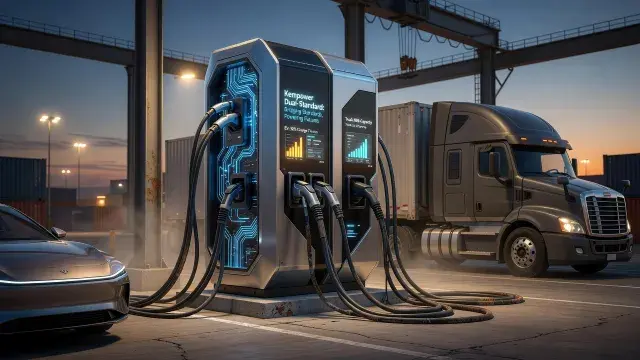
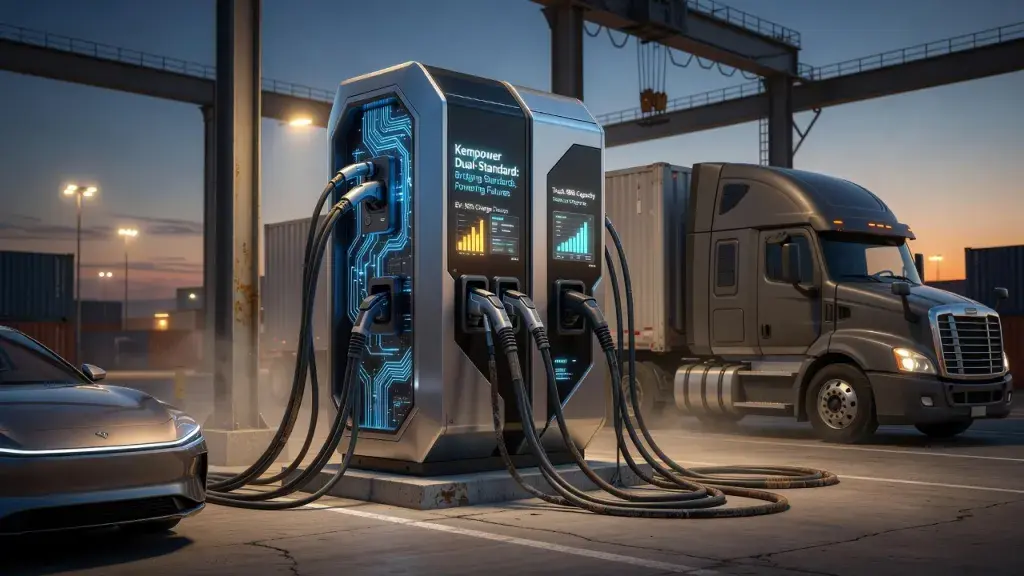
A single charging dispenser that can fuel a passenger sedan and a fully loaded semi truck within the same footprint is no longer a concept for the future. Kempower has unveiled the Mega Satellite Flex, a high-power charger that supports both the established CCS standard, at up to 560 kW, and the emerging Megawatt Charging System, at up to 1.2 MW, designed for heavy-duty trucks. The announcement came this week at the Unplug & Recharge customer and partner event held alongside ACT Expo, where the unit is on display.
The timing reflects a genuine inflection point in electric transportation. CCS has been the workhorse standard for passenger EVs for years, but it was never built with the power demands of freight trucking in mind. MCS is the industry's answer, designed to deliver the kind of throughput that can recharge a heavy truck battery in a timeframe that fits within mandated driver rest periods rather than extending them. Kempower's decision to build a charger that speaks both languages acknowledges that fleets and highway corridor operators cannot simply wait for one standard to fully replace the other; for now, and likely for a decade or more, the two will coexist. Fleet managers researching charging economics for their depots often compare hardware costs the same way consumers compare subscription costs, weighing upfront price against long-term value, in much the same spirit that drives someone toward a discounted multi-year plan for a service they know they will rely on for years. a discounted multi-year plan
One Site, Two Vehicle Classes
The practical case for the Mega Satellite Flex is about avoiding duplicated infrastructure. Charging site development is expensive and slow, involving grid connection upgrades, permitting, and civil works that often cost more than the hardware itself. Building a site for cars and a separate site for trucks means paying those costs twice. By putting both CCS and MCS output on one dispenser, Kempower is betting that operators would rather commission a single flexible installation than gamble on which standard will dominate a given location's traffic mix in five years. The charger also supports 800-volt vehicle architectures, an increasingly common design in newer EVs that allows for faster charging without proportionally higher current, easing strain on cables and connectors.
Specifications and Deployment
Kempower says the unit can deliver up to 1,500 amps on the MCS side and 700 amps for CCS, with cable lengths of 5 meters for CCS and 2.7 meters for MCS to accommodate different vehicle geometries. An optional payment terminal can be built into the dispenser, a detail that matters for public charging sites serving independent truckers and retail EV drivers who may not have fleet accounts. The Mega Satellite Flex is also compatible with Kempower's existing distributed charging architecture, meaning operators who already run Kempower satellite systems can add the new dispenser without replacing power cabinets or rewiring their sites.
What It Means for Charging Economics
Utilization is the metric that determines whether a charging site turns a profit, and idle hardware is the primary drag on returns. A dispenser that can serve both car and truck traffic from day one spreads fixed costs across a broader base of paying customers rather than sitting unused during hours when only one vehicle type is passing through. That logic matters most along highway corridors, where truck and passenger traffic overlap but arrive in unpredictable patterns. Kempower expects the Mega Satellite Flex to reach North American and European markets in July 2026, giving operators planning new sites over the next year a concrete hardware option to design around rather than a forecast to guess at.
